
Chapter Five
Mounting Mileage on the Dash

Outside of Bahkmut, an aircraft made a sharp cut back in the direction that it came from, sending off flares to counteract the Ukrainian army's attempt at taking it down. Against the echos of shelling, my friend and I made our way through the rural roads of the Donbas region towards the newly formed smoke emanating from the fields that were under the aircraft.
Our vehicle looked like any other military vehicle zooming down the backroads, our plates were blacked out from having driven through kilometers of mud, and there was a white cross, a symbol of the Ukrainian army, plastered on the sides of the van. If anything was to happen, we were in the perfect place for it, and we naturally blended into the scene.
We were on our way to Toretsk, a small town by American standards, to evacuate several cats that were being cared for by a couple of gentle souls that took them in. Along with those animals, one of the caretakers, a single mother, gave us her puppy as she believed that such transference would be better for its well-being. As tears rolled down her face, we comforted her as best as we could, reassuring her that the puppy's, and the cats’, new lives elsewhere would be ones filled with peace.
-
There’s so much destruction everywhere that I go. Kherson was just hit pretty hard the other day, the Kremlin struck a supermarket, a gas station, a train, and other non-combatant areas. We were hit in Kharkiv a few days ago, and we thought that we’d be targeted today, or really, all of Ukraine, after the dubious drone cinematically exploded over the Kremlin.
Not so much happened for this region during this time. Before the night fell on the day after that drone blew up, my friends and I had shashlik next to an old quarry that now stands as a pond of sorts. We made the most of the evening, listened to old country music, grilled wonderful food, and started planning a communal shashlik event for Kharkiv’s most heavily bombed region.
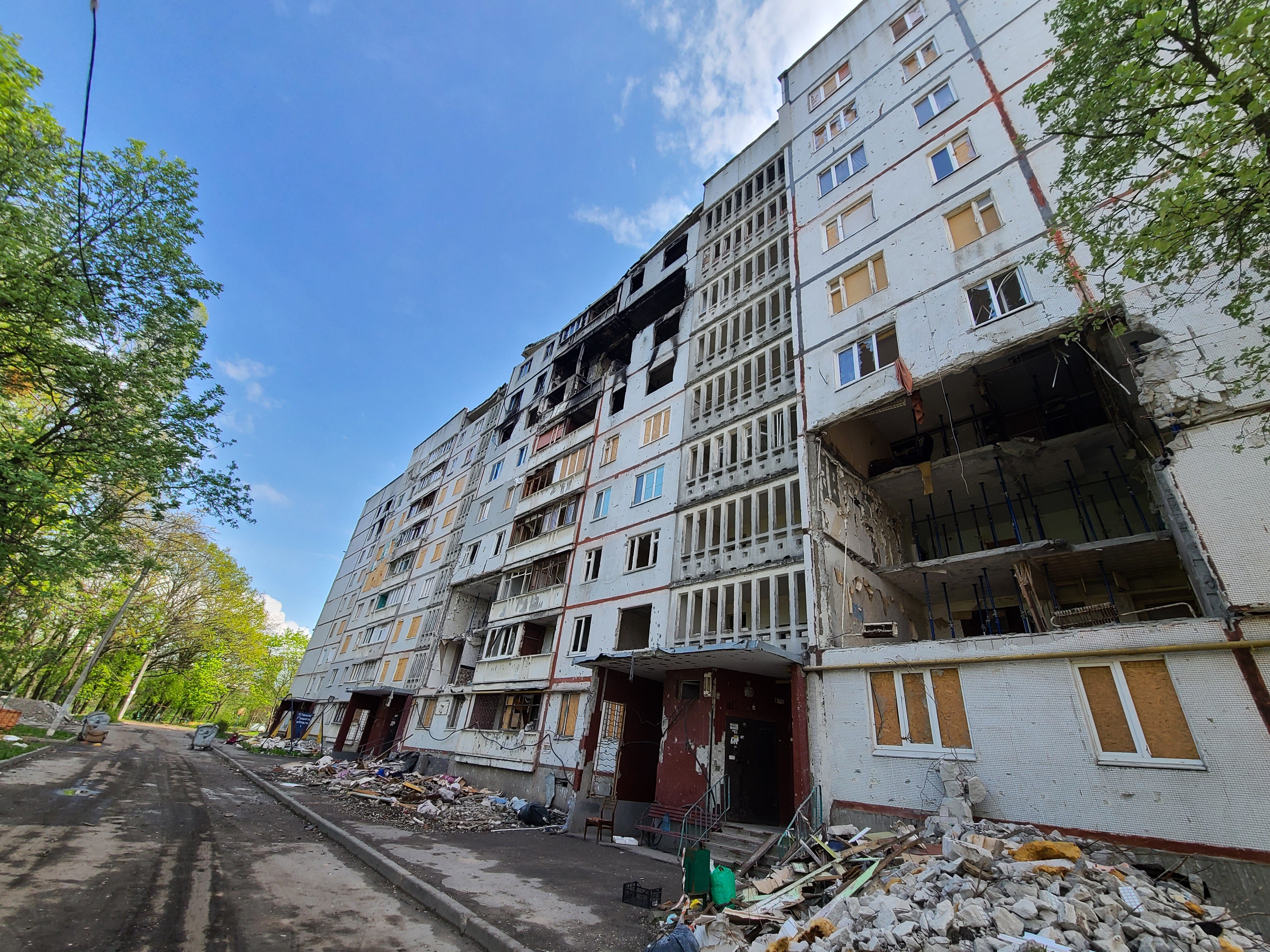
I met with a few of those locals, the residents of Saltivka, over the course of a number of trips to their district, just 36 kilometers away from the Kremlin’s borders. They were the first region of Kharkiv to be attacked, tanks rolled in, soldiers marched the streets, and artillery rained down upon this strictly residential district. Despite apartments having the word “люди,” meaning “people,” spray-painted on their facade, the message was ignored. No building was safe, from businesses to kindergartens, everything and everyone was a target for the invaders.
Since the area was de-occupied, repairs have begun, many cranes can be seen, sounds of impact drivers can be heard, and the people have been telling me that they are all waiting for their apartments to be repaired. They live here without water, without heat, without gas, and without electricity. One man lost his wife from a missile strike, took to drinking, and tried to keep a fire going inside of his already destroyed apartment. He passed out and the fire continued to grow until some other residents put a stop to it and his living there. Such conditions be damned, can’t blame the man for his grief, and all the others enduring trauma in their own ways.
This country’s reconstruction can’t simply be completed by investment firms or foreign government funding, it will take a lot more to repair the emotional damage and lives lost, resentment will be built for the indefinite future, one wholly deserved, and what will be born of this country will have a profound impact on geo-politics for post-soviet countries.
What we can do now is to try and bring back the comforts of normalcy in the midst of war, such as: spending time with friends, going out and getting a bite to eat or sharing a homecooked meal with neighbors, walking through the parks and catching whiffs of blossoming flowers, or simply sitting at home and maintaining its orderliness. These are the ways in which normalcy fights against terrorism as living in fear is becoming a victim, a consequence of falling for the Kremlin’s politically motivated campaign of brutally savage intimidation which has created an unspeakable amount of casualties.
Of course, that’s all so much fucking easier said than done, especially as I am typing this without the familiar sounds of S-300 rockets or Shahed drones over my head. I hope that I can soon plan everything out for this Saltivka “block party,” it would be a much-needed distraction from the daily reminders of the Russian Federation’s genocide.